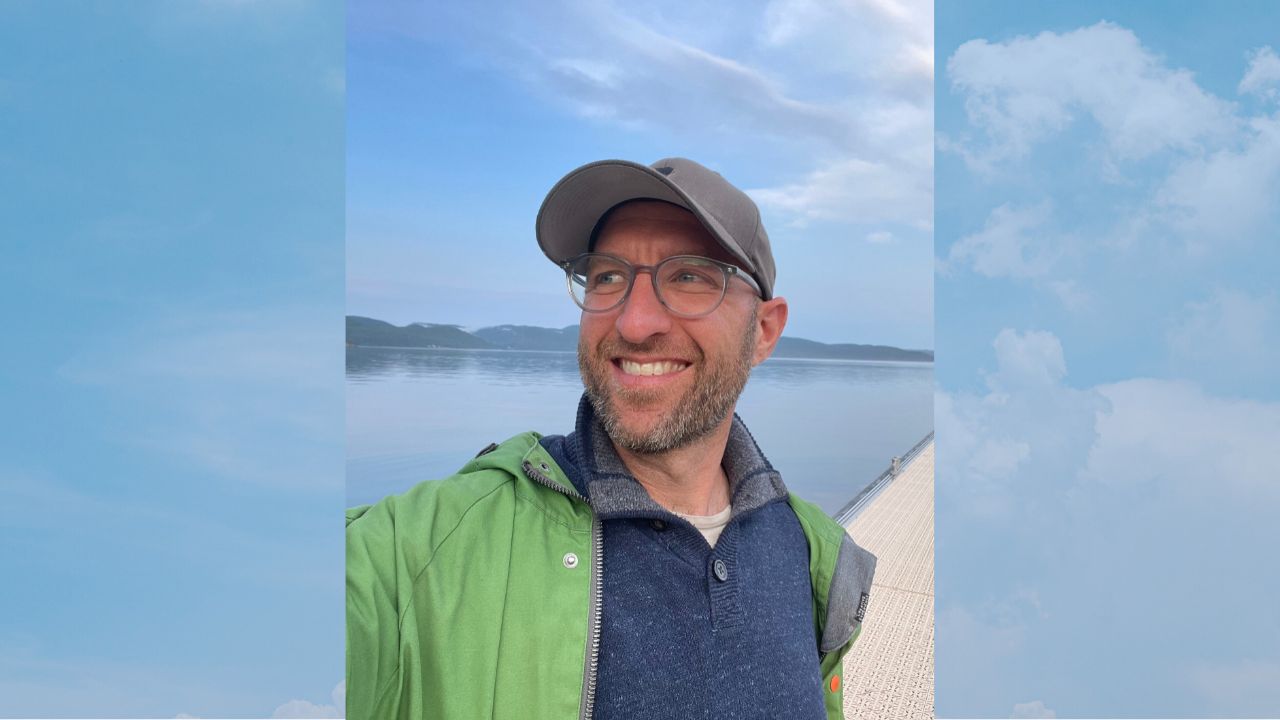


From rural isolation and housing instability to meaningful work helping others, Hayden’s learning journey has been shaped by real-life experiences and regular self-reflection. Growing up in challenging circumstances and witnessing the realities faced by unhoused communities across British Columbia, this SelfDesign alum developed a strong sense of empathy and social awareness at a young age. Over time, these experiences became the foundation for a career path based on care and purpose.
Hayden attended SelfDesign from age 11 to 16. He credits SelfDesign’s flexible, interest-based approach with helping him recognize that learning was already happening in his everyday life. Through regular reflection encouraged by SelfDesign along the learning journey, and the support and guidance of his learning consultant, Rana Lande, he was able to make sense of his experiences and see how they connected to his growth.
“One of the biggest things I took away from SelfDesign was learning how to recognize educational value in things I was already doing,” Hayden reflects. “Writing regular reflections helped me see that learning doesn’t just happen in classrooms or textbooks. It actually happens all the time, if you’re paying attention. Having a Learning Consultant also made a big difference, especially as I got into later grades. That extra support helped with navigating the education system while still letting me learn in a way that worked for me.”
Hayden spent part of his childhood in a very remote area of the Okanagan, where he was homeschooled and experienced long periods of isolation. When his family moved to B.C.’s coast when he was 10, he was exposed to some of the harsh realities of urban life, including witnessing the struggles of the area’s large unhoused population.
“It was a big culture shock,” he shares. “Seeing how unhoused people were treated stood out to me right away, because it felt like they weren’t even being seen as people. Later, when I lived in Prince George, the cold was extreme, and I witnessed people dying regularly throughout the winter. The attitudes of the average person toward people living on the street were horrific. On top of that, I had some close brushes with homelessness myself. There were periods where our housing was extremely precarious, and I lived in a tent for a while. I also witnessed a close friend battle addiction and barely survive it.”
Witnessing such grief, loss and injustice started to weigh heavily on Hayden. He describes feeling a lot of anger during those years, an anger that eventually became a significant turning point.
“The fact that my anger affected me that deeply, for days at a time, made me realize that I needed to do something with that feeling instead of just carrying it,” Hayden shares. “That was when I started thinking that maybe this was something I should turn into my work.”
At SelfDesign, Hayden learned how to pause, reflect and notice patterns in his experiences. This way of learning helped him understand that his responses to the world around him were meaningful, and that they could inform his future direction.
“One of the biggest things I remember from SelfDesign was learning how to recognize educational value in things I was already doing,” shares Hayden. “SelfDesign taught me how to learn independently and reflect on my progress. Those skills didn’t just help me in school, they shaped how I navigate work, decisions and life as an adult.”
Today, Hayden works as a shelter support worker at Kelowna’s largest low-barrier homeless shelter. His role includes crisis response, overdose intervention and building trust with people who are often deeply marginalized. Looking ahead, he plans to pursue a Bachelor of Social Work and continue supporting individuals experiencing homelessness, mental health challenges and substance use.
Hayden’s brief experience in public school in grade 10 left him feeling rushed and constrained by a system that didn’t allow space for reflection or personal meaning. SelfDesign’s non-linear approach gave him permission to slow down and listen to himself after commencement.
“I didn’t take a traditional path after high school,” he explains. “I spent a lot of time working different jobs and moving around the province, trying to figure out what actually felt meaningful instead of rushing into post-secondary just because that’s what you’re supposed to do. I wanted to be sure about what I was committing to.”
Hayden’s story is a reminder that when learners are given time, trust and support, they can turn lived experience into meaningful work. Within a self-directed learning environment, young people are encouraged to reflect and discover paths that align with who they are and what matters to them.